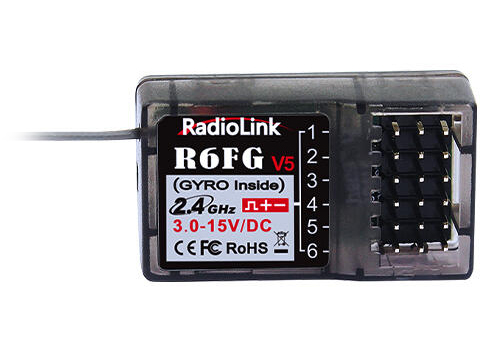
RC8X 8-channel radio with 2 R8FG and 2 R4FGM receivers
The RC8X is an 8-channel transmitter for RC cars, boats and robot projects. It is operated from a 4.3-inch colour touchscreen rather than the small LCD and button rows used on most surface radios, and it stores settings for up to 200 models. This version ships with four receivers, all with an integrated gyro: two R8FG for ordinary cars and boats, with IPX4 splash protection and real-time telemetry, and two R4FGM, 3 g mini receivers for small models and tight installations. Four models can be set up from the start.
Ground range reaches 600 m with an R8FG under open conditions and the response time goes down to 3 ms with a digital servo and a V2.1-marked receiver. Voice prompts, eight groups of programmable mixing and an FPV view on the built-in screen are all configured from the touchscreen menu itself, with no programming involved.
Key facts
- Eight groups of programmable mixing, including 4WS, brake, tank and tilt
- Live telemetry on screen: RSSI, receiver voltage and model battery voltage
- The screen doubles as an FPV view with an external 5.8 GHz receiver module
- DSC port for RC simulators, FPV head tracking or a TBS Crossfire module
- Menus and voice prompts in 12 languages, the last two added by firmware V1.3.6
- 32 GB microSD card supplied, and the radio needs one inserted to run
- Wheel mounts on the left or the right, adjustable trigger spring and slider
| Channels | More8, or 16 after a free firmware upgrade |
| Model types | MoreCars, boats and robots |
| Display | More4.3 inch IPS touchscreen, 800 × 480 pixels |
| Range on the ground | MoreUp to 600 m with the R8FG, 400 m with the R4FGM |
| Response time | More14 ms analog, 4 or 3 ms digital |
| Model memory | 200 models |
| Included receivers | More2 × R8FG, 8 channels, and 2 × R4FGM, 4 channels, all with gyro |
| Power | More8 AAA, 2S–4S LiPo or 6S NiMH |
| Weight | More438.5 g |
Advanced specifications
Channels and firmware
The RC8X leaves the factory as an 8-channel radio. Firmware V1.3.5, released in May 2026, expands it to 16, and the upgrade is free. The current release is V1.3.6, so a radio on the latest firmware has the wider channel count.
The extra channels need a receiver that can carry them. The receivers supplied here carry eight channels (R8FG) and four channels (R4FGM), so using all 16 channels calls for an R16F, which is sold separately. For eight channels or fewer, nothing has to change.
Firmware is installed over the USB Type-C port, downloaded from radiolink.com/rc8x_firmware
Screen, menus and voice
The 4.3-inch IPS touchscreen runs at 800 × 480 with a backlight and a narrow bezel, and is navigated by touch rather than by the button rows and small monochrome LCD used on most surface radios.
Settings menu, font, desktop, system theme, language and voice prompts are all changed on the radio itself. Voice prompts cover low transmitter, receiver and model battery voltage, low RSSI and the operating modes, and their language, format and content can be edited; your own voices, styles, intonations or dialects require a custom voice pack. The 3.5 mm headphone jack lets prompts be heard in noisy surroundings or kept discreet.
Menu languages: Simplified Chinese, Traditional Chinese, English, Japanese, Spanish, German, Russian, French, Korean, Polish, Portuguese and Dutch. The last two arrived with later firmware, so a radio on an older release shows fewer.
FPV on the built-in screen
With an analog 5.8 GHz receiver module connected, the screen splits: the transmitter menu stays in the upper half and the live picture from the model fills the lower half.
The module and a camera with a video transmitter on the model are both needed, and neither is included. Any analog 5.8 GHz receiver works; the requirement is a composite video signal. The module's cable goes into two ports at once, the 3.5 mm jack for video and the USB Type-C port for power, so it runs off the radio.
The 3.5 mm jack switches from audio output to video input, so headphones and FPV cannot be used at the same time. Digital video systems are not supported; the screen shows analog video only.
Setup is covered in section 2.1.9, External input output, of the manual.
Range and response
FHSS spread spectrum with 67-channel pseudorandom frequency hopping gives interference protection within and between frequency bands. Range on the ground reaches 600 m with an R8FG and 400 m with an R4FGM, both under open, interference-free conditions.
Servo speed is selectable at 14 ms, 4 ms or 3 ms. 14 ms is the default and is the setting for an analog servo. 4 ms and 3 ms are the digital servo settings, and reaching them takes three things at once: firmware V1.1.5 or later on the transmitter, the FHSS V2 protocol selected, and a receiver that supports digital servo speed: an R8FG V2.1 or R4FGM V2.1, or an R8FG or R4FGM manufactured on 26 April 2023 or later.
Ports and expansion
- DSC port for a simulator, FPV head tracking or a long-range module (described below)
- USB Type-C for firmware upgrades, or temporary power from a computer or power bank
- 3.5 mm headphone jack
- Mount point for the FPV display holder accessory, a bracket for a phone or a separate monitor
- 32 GB microSD card supplied, and the radio does not run without a card inserted
- Compatible with TBS Crossfire and ELRS long-range modules; powering an ELRS module from the Type-C port takes a separate 5 V boost module
The FPV display holder and the thumb lever are accessories and are not included.
The DSC port does three different jobs, set in the menu under External input output, one at a time. Head tracking and a long-range module cannot run together. No DSC cable is included.
Simulator. Set to PPM_OUT, the port sends a PPM signal to a computer so the radio can drive an RC simulator. VRC Pro, CarX and Assetto Corsa Competizione are supported. A PPM-to-USB lead is needed.
FPV head tracking. Set to PPM_IN, the port reads the signal from goggles with head tracking built in, and the radio passes that movement out on ordinary RC channels, typically to a pan and tilt camera mount on the model. Two-axis and three-axis trackers both work. The channels used depend on the goggles and have to be set to NULL in the channel menu first. The Scorpion head tracker is not compatible: its PPM range of 1000–2000 does not match the RC8X range of 300–1700.
TBS Crossfire and ELRS. Set to CRSF, the port takes the signal lead from a long-range module. It carries signal only and does not power the module. A Crossfire module in high power mode increases the control range considerably.
All three are covered in section 2.1.9, External input output, of the manual.
Mixing, telemetry and gyro
Eight groups of programmable mix control cover nine mix types: steering, brake, gyro, 4WS, dual ESC, CPS, tank, tilt and free programmable mixing. The four most used:
- 4WS mixing for crawlers, logging trucks and other four-wheel-steering vehicles
- Brake mixing, front and rear wheels adjusted independently, for example on larger 1/5 petrol cars
- Tank mixing for twin-motor vehicles such as tanks
- Tilt mixing for boats, where simple parameter setting and smooth control matter
Telemetry covers RSSI, receiver voltage and model battery voltage. RSSI and receiver voltage appear once binding is complete. Model voltage requires the cable to be connected to ESC and battery: up to 14S, 58.8 V with the R8FGH and up to 8S, 33.6 V with the R7FG and R8FG. The R4FGM reports signal strength and RSSI, not voltage, so a model that should send its battery voltage to the screen runs an R8FG.
All four included receivers have an integrated gyro and support high-voltage servos. The gyro helps the vehicle hold its line, smooths cornering and reduces drift at higher speeds. Sensitivity sits on CH8 on the R8FG and on CH3 on the R4FGM, and is controlled by the DL1/PS3 knob switch or in the gyro mixing menu.
The R8FG is the full-size receiver for ordinary cars and boats: eight channels, IPX4 splash protection and voltage telemetry. The R4FGM weighs 3 g and measures 25 × 13 mm, which fits mini cars, small crawlers and tight tank and robot installations where the R8FG is too large. It has no IP rating and carries four channels.
Power and ergonomics
The transmitter is powered by either 8 AAA batteries, a 2S–4S LiPo pack or a 6S NiMH pack, all within the 7–17 V operating range. A 7.4 V 1700 mAh lithium battery matches the battery compartment and gives around 7 hours of standby. It is an accessory and is not included. RadioLink's voltage protection software and the JST connector guard against reverse polarity.
A computer or a power bank connected over Type-C keeps the radio running temporarily, for instance while settings are made at the bench or firmware is updated. The port takes 5 V and must not exceed 5.5 V. It does not charge the battery, and the battery should be taken out while the radio runs on USB so it is not slowly discharged.
Trigger spring tension and trigger slider are adjustable and the wheel mounts on either side, so left-handers are covered. A lanyard is included.
Compatibility
Receivers: R8FG and R4FGM (both supplied), R16F, R16SM, R12F, R8EF, R8FM, R8SM, R8XM, R8FGH, R7FG, R6FG, R6F, R8F and R4F. Ground range depends on the receiver: 600 m with the R8FG, 400 m with the R4FGM, less with the smaller ones.
Model types: crawlers, drag racing cars, drift cars, monster trucks, short course trucks, bashers, off-road cars, petrol and mini RC cars, tanks and tracked vehicles, boats, sailboats, trimarans, bait boats, remote-controlled life buoys and robot projects.
Flight controller hardware over SBUS: ArduPilot, Pixhawk, BetaFlight, Arduino and Raspberry Pi. SBUS comes from the R8FG on CH8; the R4FGM outputs PWM only.
Technical specifications
| Model | RadioLink RC8X |
| Product type | 8-channel transmitter |
| Size | 121 × 163 × 209 mm |
| Weight | 438.5 g |
| Antenna | Built-in |
| Battery compartment | 92 × 52 × 14.5 mm |
| Frequency band | 2.4 GHz ISM, 2400–2483.5 MHz |
| Spread spectrum | FHSS, 67-channel pseudorandom frequency hopping |
| Channel resolution | 4096 |
| Display | 4.3 inch, 800 × 480 pixels, full colour, backlit IPS touchscreen |
| Model memory | 200 model groups |
| Memory card | 32 GB microSD supplied; required for the radio to run |
| Range on the ground | Up to 600 m, open and interference-free |
| Operating voltage | 7–17 V DC; 8 AAA batteries, a 2S–4S LiPo or a 6S NiMH pack |
| Operating current | 250 mA ±10 mA @ 8.4 V backlight on; 190 mA ±10 mA backlight off |
| Type-C input | 5 V, 500 mA, temporary power that does not charge the battery |
| Type-C output | 4.6–5.0 V, max 1 A |
| DSC port | Input 0–5 V, output 0–3.3 V |
| Modulation | GFSK |
| Transmitter power | <20 dBm |
| Response time | 3, 4 or 14 ms, selectable |
| Low-voltage alarm | Customisable for transmitter, receiver, model battery and RSSI |
| Operating temperature | -30 °C to 85 °C |
R8FG receiver, 2 supplied
| Product type | 8-channel receiver with integrated gyro |
| Size | 35 × 24 × 13.5 mm |
| Antenna length | 205 mm |
| Weight | 10.5 g |
| Signal output | PWM on CH1–CH7, SBUS on CH8 |
| Operating voltage | 3–12 V |
| Operating current | 35 mA at 5 V |
| Telemetry | Model battery voltage, RSSI and receiver voltage |
| Splash protection | IPX4 |
| Control range | Up to 600 m |
| Compatible transmitters | RC8X, RC6GS V3, RC4GS V3, RC6GS V2, RC4GS V2, RC6GS (3-position switch version), RC4GS (produced after 2018-01-01), T16D, T12D, T8FB, T8S |
R4FGM receiver, 2 supplied
| Product type | 4-channel receiver with integrated gyro |
| Size | 25 × 13 mm |
| Antenna length | 90 mm |
| Weight | 3 g |
| Signal output | PWM on CH1–CH4 |
| Operating voltage | 3–10 V DC, high-voltage servos supported |
| Operating current | 30 mA at 5 V |
| Telemetry | Signal strength and RSSI |
| Channel resolution | 4096 |
| Control range | Up to 400 m |
| Operating temperature | -30 °C to 85 °C |
| Compatible transmitters | RC8X, RC6GS V3, RC4GS V3, RC6GS V2, RC4GS V2, RC6GS (3-position switch version), RC4GS (produced after 2018-01-01), T16D, T12D, T8FB, T8S |
Good to know
Maximum range is measured in open areas without interference and varies with the model, installation, antenna placement and surroundings. The 3 ms response requires a compatible receiver, the right firmware version and the FHSS V2 protocol. The IPX4 splash rating applies to the R8FG; RadioLink gives no IP rating for the R4FGM. Some functions need accessories that are not included: an external 5.8 GHz receiver module, an FPV display holder, a thumb lever, TBS Crossfire or an ELRS module.
Full manual: radiolink.com/rc8x_manual
Specifications according to the manufacturer. Range, response time and battery life depend on installation and conditions.